
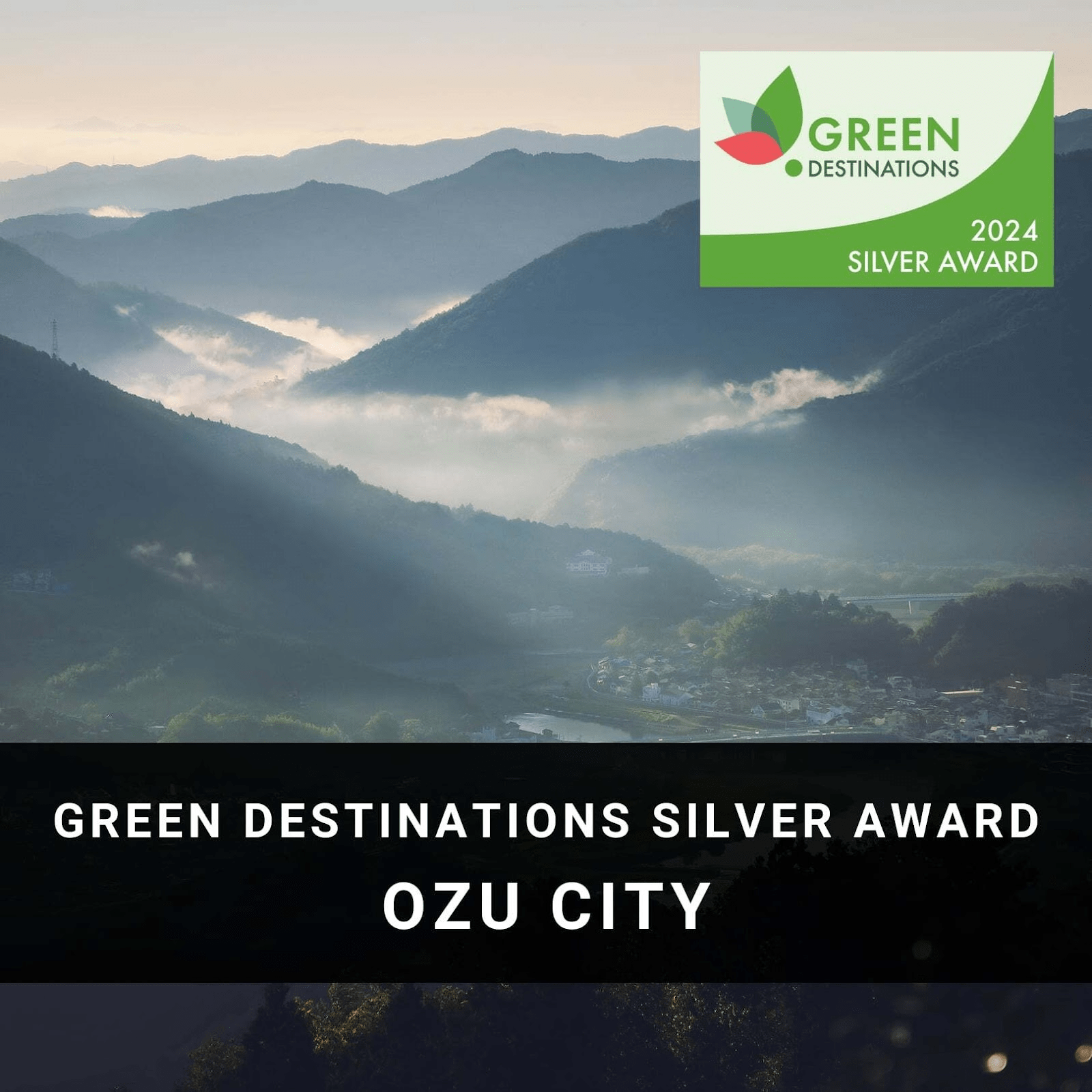

In 2023, Ozu City—a small castle town in Ehime Prefecture—took top honors at a global sustainable tourism awards ceremony. This was achieved without massive capital investment or the creation of any outlandish attractions.
The driving force behind this was a “true partnership” in which the government and the private sector shared risks and commitments, as well as the perspective that value lies not in seeking “correct answers” from outside sources, but rather in the “dedication” and “high level of planning” inherent within the local government itself.
So, how can the public and private sectors become true partners? We spoke with Yosuke Inoue of Kita Management—the driving force behind this reform—to learn about the methods and philosophy that many regions can apply.
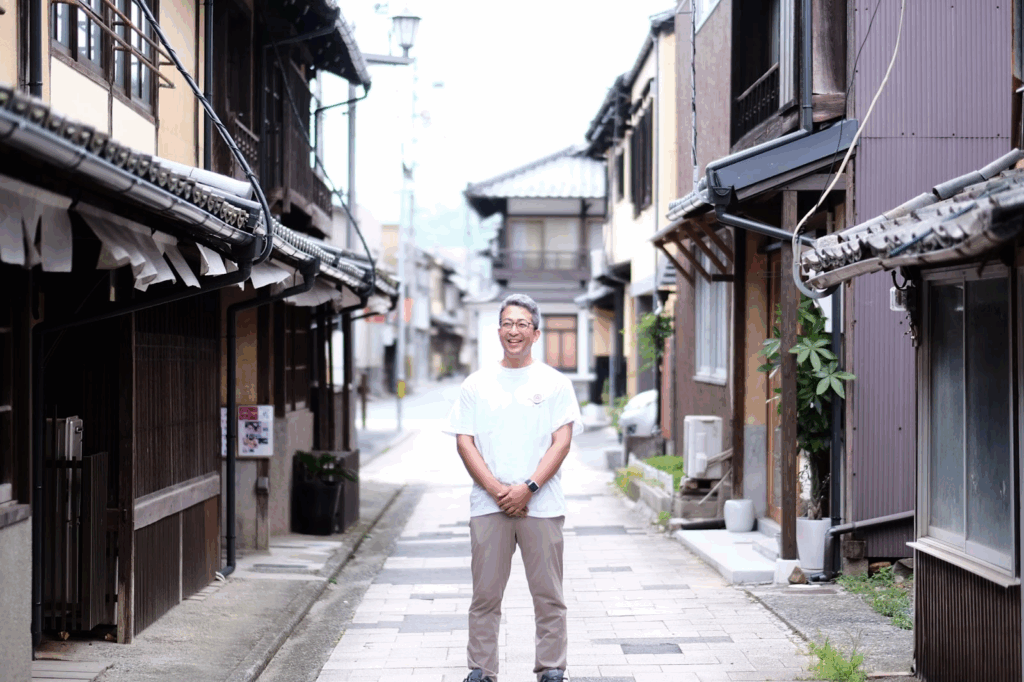
Yosuke Inoue
Kita Management, General Incorporated Association
Section Chief, Planning Division; CMO; and Representative Director of KITA Co., Ltd.
Born in Ozu City, Ehime Prefecture. After graduating from Kyushu University and its graduate school, he joined Sojitz Corporation. Following assignments in the Global Human Resources Development Section of the Human Resources and General Affairs Department and a secondment to a startup, he returned to his hometown to serve as a member of the Ozu City Regional Revitalization Corps. While serving in this role, he was involved in the establishment of the regional DMO, the General Incorporated Association Kita Management, and founded KITA Co., Ltd., a real estate investment company and affiliate of Kita Management, in fiscal year 2018. Currently, based in Ozu City, Ehime Prefecture, he is revitalizing traditional houses as the owner of “NIPPONIA HOTEL Ozu Castle Town,” Japan’s largest decentralized hotel, which utilizes historic resources such as traditional farmhouses and townhouses.
─── Please tell us about the background behind your decision to aim for an award from “Green Destinations,” an international certification organization for sustainable tourism.
The catalyst was our selection as a model district for the “Japanese Sustainable Tourism Guidelines (J-STSD),” a program led by the Japan Tourism Agency in fiscal year 2021. Taking this as an opportunity, we launched full-scale initiatives aimed, in the short term, at winning the “Green Destinations” award—a global sustainable tourism award—and, in the medium to long term, at obtaining certification.
To begin with, the decision to apply to become a model district was driven by major shifts in broader societal trends. In particular, the COVID-19 pandemic, which began in 2020, has brought about a significant shift in attitudes toward tourism.
I feel that this was a time when questions such as “Shouldn’t we be considering sustainability?” and “Were our past practices really the right ones?” came to the forefront across the entire tourism industry.
As the national trend toward “sustainable tourism” becomes increasingly clear, we have decided that we, too, should brand our region in line with that direction.
When we looked at the path our company should take from a macro perspective, “sustainable tourism” was an element we absolutely could not overlook. That was our initial motivation for volunteering to become a model district.
─── Was there some kind of formative experience related to sustainability that served as the foundation for Kita Management’s activities?
Our organization was originally founded with the goal of “restoring traditional Japanese houses and passing them on to future generations in a sustainable manner,” and we felt that this aligned very well with the philosophy of sustainable tourism.
We opened our traditional Japanese inn—a restored historic house—in 2020, but its opening coincided with the COVID-19 pandemic. As we looked beyond this situation and considered “how to put our region on the map,” we became convinced that our long-standing efforts to restore historic houses were precisely what would allow us to ride the wave of this new era.
─── Once you began working toward certification, what difficulties or initial challenges did you encounter?
Based on my experience working on obtaining international certifications in the agricultural sector at my previous job, I was confident that “I could definitely put this expertise to good use.”
And when I actually met with representatives from local governments, that conviction grew even stronger. Japanese local governments are very conscientious and already have solid, high-quality comprehensive plans, rules, and guidelines in place.
That’s why I immediately realized that the real issue boiled down to one thing: “that information is confined to specific departments and is difficult for outsiders to access.”
─── So, all we had to do was “make visible” the excellent initiatives that were already in place, in accordance with international standards, right?
For example, Ozu City already had an excellent plan in place to address climate change called the “Fourth Greenhouse Gas Reduction Plan.” However, awareness of these efforts was limited to the Environmental Division and a few stakeholders.
When we discovered this plan during the application process and included it in our documents, it was duly recognized as an evaluation criterion.
Through this experience, I realized once again that “Japanese companies and local governments are doing what they need to do; it’s just that the message isn’t getting across.”
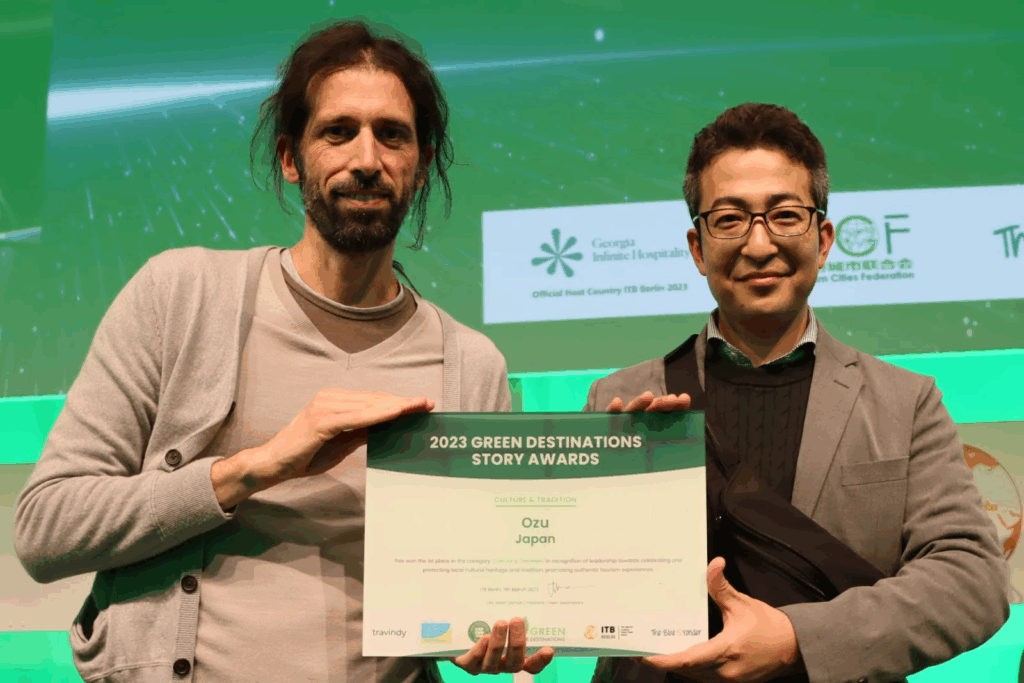
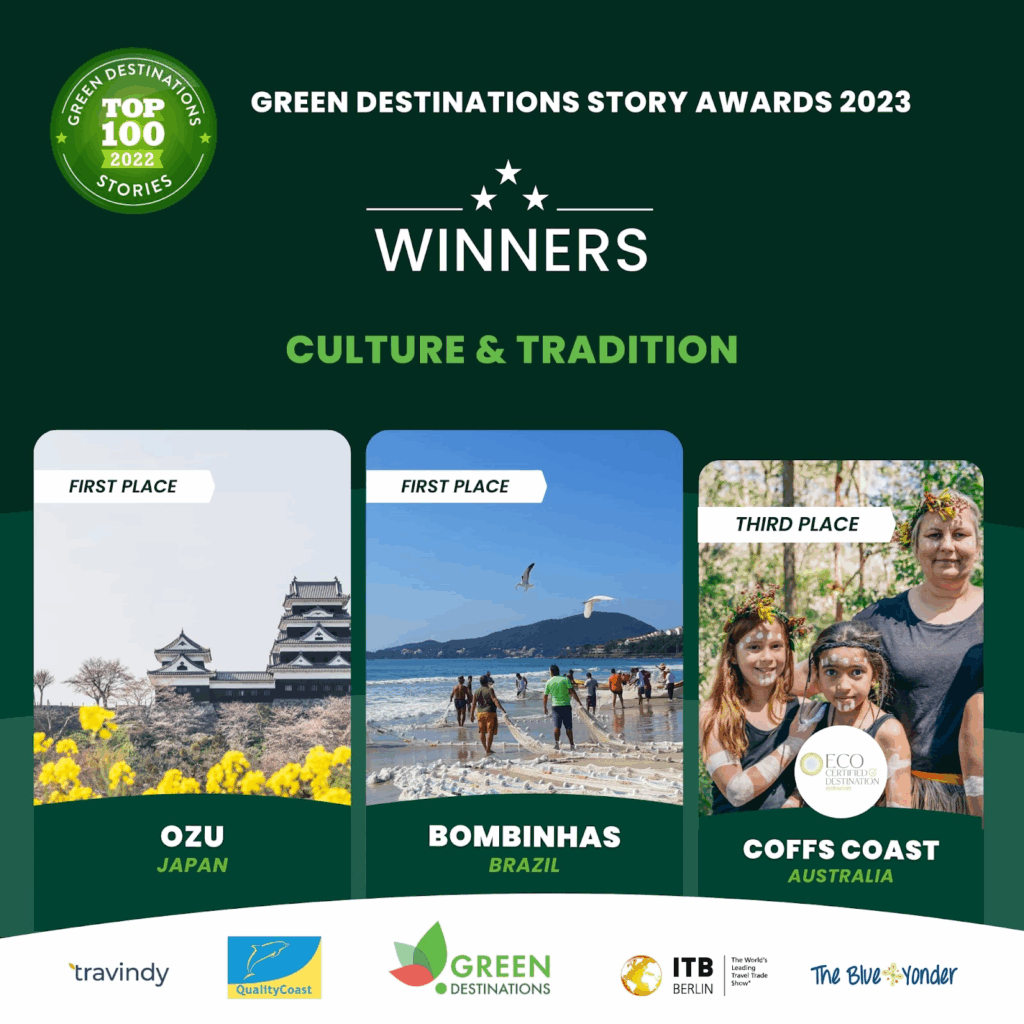
Ozu City, Ehime Prefecture, was recognized for its efforts and was named the global winner in the “Culture & Tradition” category at the 2023 “Story Awards” hosted by Green Destinations.
They were honored at “ITB Berlin,” one of the world’s largest travel trade shows, held in Germany.
─── Did winning the world No. 1 award have a significant impact on your media exposure?
Yes, the response was very positive. We received direct inquiries not only from domestic and international travel agencies but also from industry professionals and media representatives we met at ITB Berlin.
What I found particularly interesting was the “reversal” in which Europeans knew they wanted to visit Ozu, yet representatives from Japanese DMCs (travel agencies) would ask, “Where is Ozu?”
We received many inquiries that led to concrete business discussions, and we feel this had a definite effect in stimulating demand.
─── Were most of the inquiries from people who actually wanted to develop tours or come on a fact-finding visit?
I’ve heard that the most common inquiries we received from DMCs (travel agencies) were regarding tour development. Unfortunately, however, these did not immediately result in contracts. There are two main reasons for this.
First, there was a time lag between the award and the lifting of Japan’s entry restrictions. As of March 2023, when the award ceremony took place, entry restrictions were still in place, and by May or June—when the country began welcoming visitors in earnest—the story had already lost some of its newsworthiness.
Another factor was that the travel industry as a whole was scrambling to keep up with the explosive post-COVID demand. Many travel agencies were in a situation where they were “already stretched thin just arranging trips along the Tokyo–Osaka ‘Golden Route,’” leaving them no room to develop new travel products. Compounded by a labor shortage, it took about a year and a half for the industry to stabilize.
For that reason, even though we were recognized as the best in the world, it wasn’t until very recently that we were actually able to bring the product to market.
─── Do you have any message for local governments that are considering getting involved with Green Destinations, particularly those thinking about entering the “Top 100”?
Based on my experience, I can say with certainty that you shouldn’t “leave it entirely up to the DMO.” If local government staff cooperate, the certification process will undoubtedly go more smoothly.
I, too, started out drafting applications as a DMO staff member, but as I mentioned, there’s a wealth of information just waiting to be uncovered within city halls and local government offices.
Partway through the process, a city employee agreed to become a co-applicant, and we shifted to a system where that person gathered the necessary documents using the city hall’s internal network. As a result, the process of gathering the documents was completely different from when I had been handling it myself.
If a local government is taking the lead, rather than simply outsourcing the work to a DMO and leaving it at that, having the local government’s staff actively involved will ensure the project’s success and, as a result, significantly reduce the burden on all stakeholders.
─── So, the ideal situation is a system in which DMOs and local governments work together as a unified team while each continues to develop its own areas of expertise.
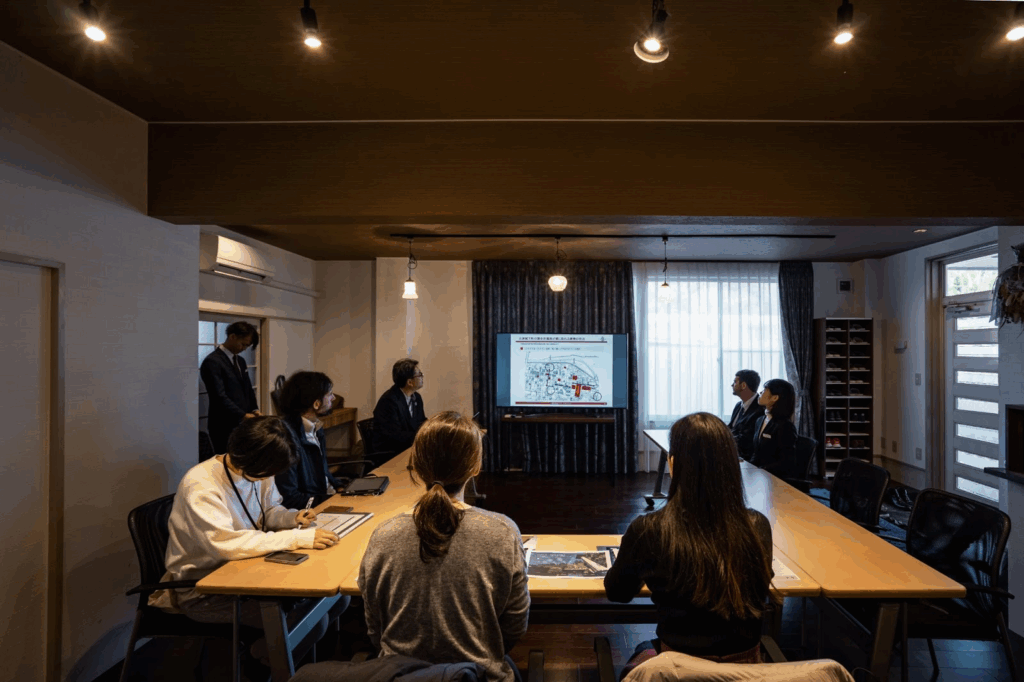
That’s right. Ideally, both the DMO and City Hall should have staff members with specialized knowledge.
We at Kita Management also have staff members who have completed the GSTC* training program. In addition, since last year, we have had staff members from the Ozu City Hall participate in the GSTC training, and some of them have actually passed the certification exam.
I am confident that having staff members with specialized knowledge on the local government side will strengthen the collaboration between the two organizations and significantly boost the momentum of the entire project.
*GSTC: Global Sustainable Tourism Council. An international nonprofit organization established by the United Nations World Tourism Organization (UNWTO*—now UNTourism) and others, which develops and manages the “GSTC Criteria,” a set of international standards for sustainable tourism.
─── Has this global recognition brought about any positive changes—not just for the tourism industry, but for the entire region?
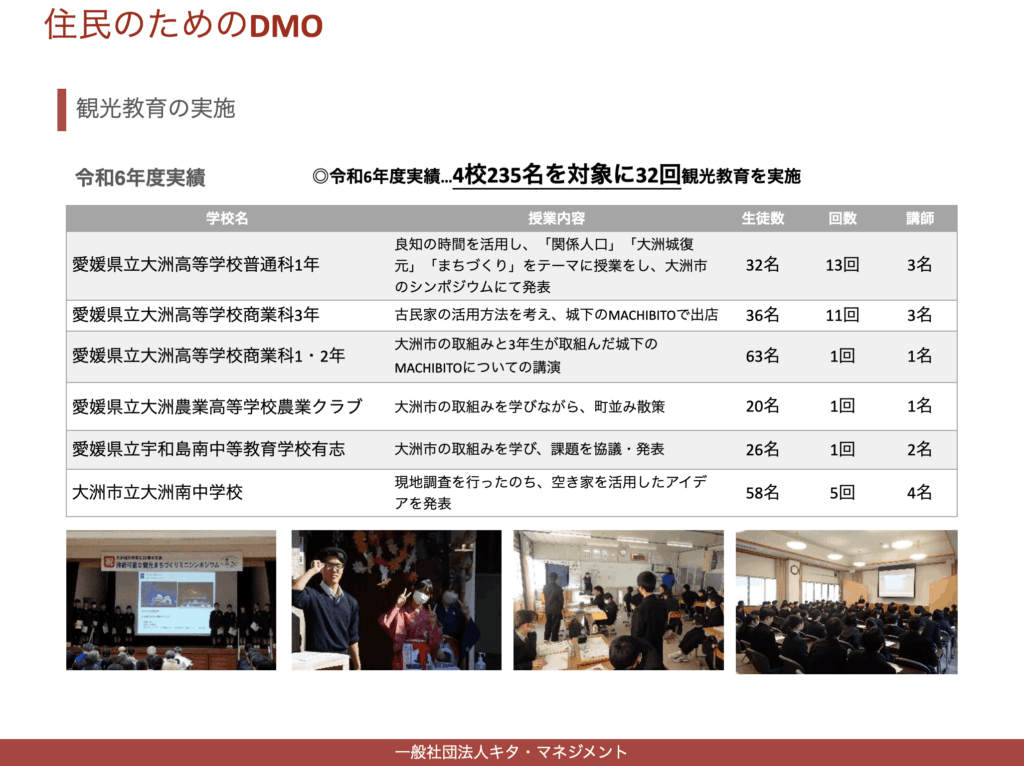
Interest in “tourism education” in the community has grown significantly. Even before we took any action, we began receiving requests from local schools asking us to “come and speak to the children.”
I think this was linked to the SDGs education that every school is implementing, as news reports highlighted our achievement of becoming the world’s best. We now have a dedicated staff member, and the number of opportunities to visit elementary, middle, and high schools to teach classes has increased significantly.
─── Are there any initiatives in place to foster a sense of civic pride among local residents, particularly among the older generation?
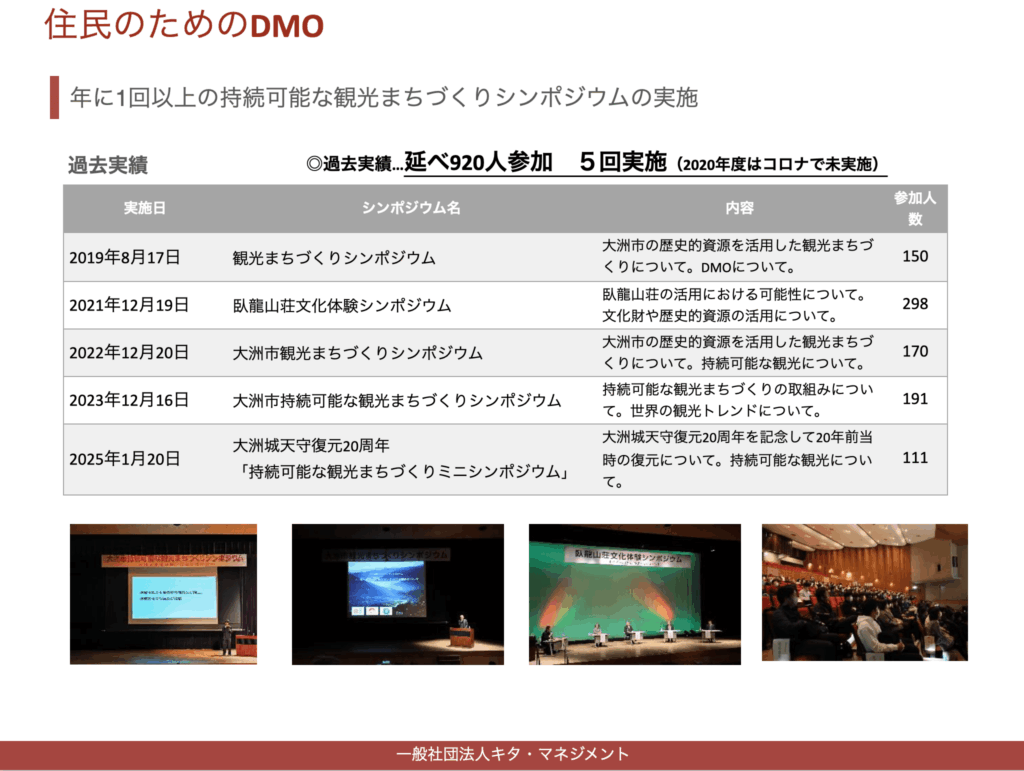
While we engage with children through classroom lessons, we provide a forum for dialogue with adults at an annual symposium. We have been holding this event every year since 2019 in collaboration with Ozu City, and we use it as an opportunity to share the current status of our initiatives with the participation of experts.
The purpose of this symposium is to invite experts and help citizens understand “what sustainable tourism is,” while also sharing the value of tourism and how it can contribute to the region’s future.
─── This town-building initiative began with the revitalization of vacant homes. Could you tell us about the current phase and the ultimate goal for the future?
Our first phase was to create the “tourism” industry itself in this town. Since there used to be almost no lodging here, our initial goal was to form an “industrial cluster” where tourism businesses could gather.
Today, accommodation facilities have been established, and the area has grown to be home to 28 tourism businesses. With the initial four-year investment plan now complete, the project has entered a phase of stability, where we are continuing to revitalize small-scale properties while enhancing the profitability of the business.
In the next phase, we at DMC will create a system that enables the businesses that have joined us to turn a profit. Up until now, we have been laying the “foundation” for the industry, but we believe our mission going forward is to make that foundation even stronger and expand it further.
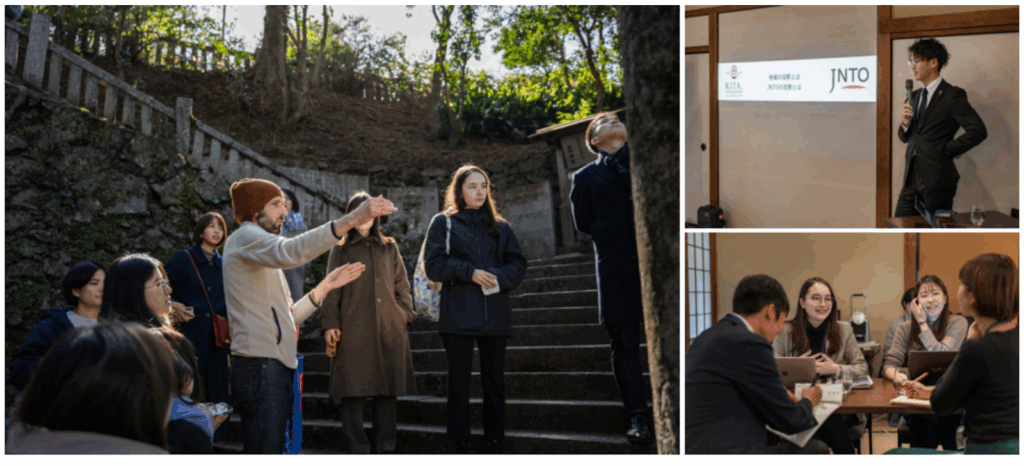
The remarkable success in Ozu drew earnest requests from many companies and local governments, both in Japan and abroad, who wanted to “learn from their methods.” Kita Management’s challenge extends far beyond simply revitalizing its own region.
To give back to society based on that experience, the organization also runs its own training programs. Participants can learn the practical knowledge behind its success—ranging from real-world know-how on public-private partnerships to the philosophy of sustainable tourism.
─── What prompted you to start offering corporate training?
There are two main reasons for this. First, I have long felt that the theme of “sustainable tourism” aligns very well with corporate talent development.
Based on my own experience in my previous job, where I was involved in training programs for global talent, I was convinced that our efforts are deeply connected to contemporary issues such as sustainability.
Second, we actually received a large number of requests for site visits. We received a steady stream of requests from a wide variety of organizations—including companies, local governments, and banks—which made us realize that there is a clear demand for our activities.
For these reasons, we decided to systematize our insights and offer them as training programs for corporations.
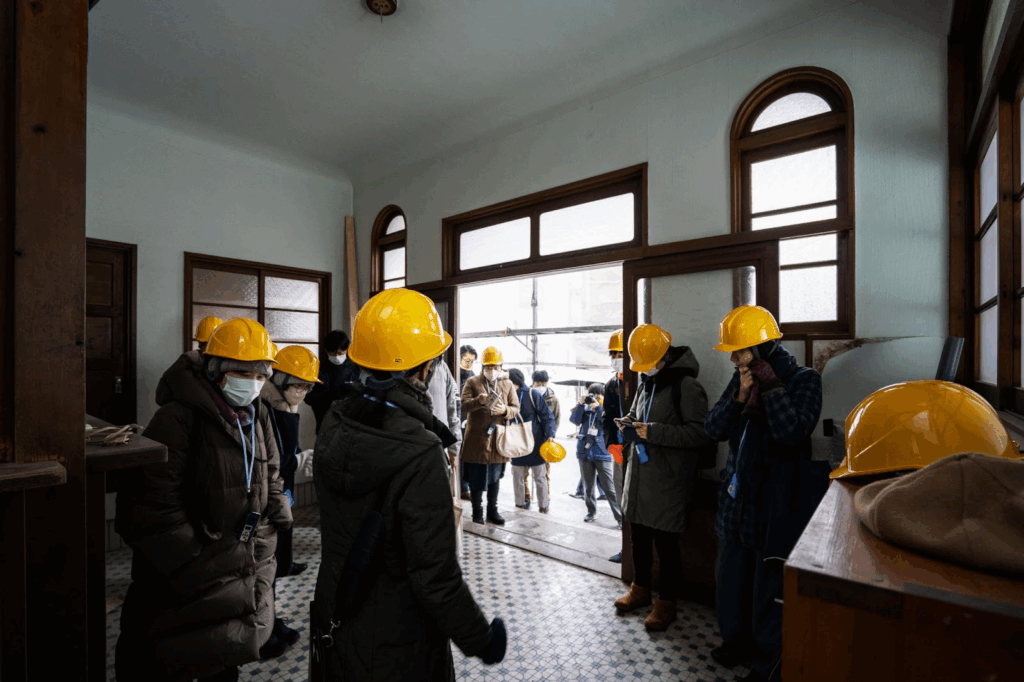
─── I hear that various companies come here on study tours. What aspects do you think they’re most interested in learning about?
What attracts the most interest is our “public-private risk-sharing model.” Our historic house restoration project is a truly public-private partnership, with the city and the private sector each contributing exactly half of the funding.
While there are many nominal public-private partnerships across the country, we believe our case serves as a concrete example of how the public and private sectors can share risks and move projects forward together. In fact, many people visit us specifically to learn how to apply this model to their own business operations.
─── Finally, please tell us what message you, Mr. Inoue, would most like to convey going forward.
Our initiative goes beyond simply restoring traditional Japanese houses; it is a training program designed to help participants learn a “philosophy” for addressing the challenges facing Japan’s future.
For example, the other day I conducted a training session for the executive team of a beverage manufacturer. At first glance, this may seem unrelated to regional revitalization, but the problem of vacant homes in Ozu is a microcosm of Japan—one that cities like Tokyo and Osaka will eventually face as well.
We present this reality and ask, “How will your company address these societal changes?”
Our answer to that question is a philosophy of “thoroughly involving others.” We haven’t limited our thinking to city hall or the DMO alone; rather, it is precisely because we have been determined to actively engage external expertise and capital—such as from hotel management professionals and financial institutions—that we have become what we are today.
We believe that this “problem-solving mindset” is the greatest value we can offer—one that any company can apply to thrive in the future.

